
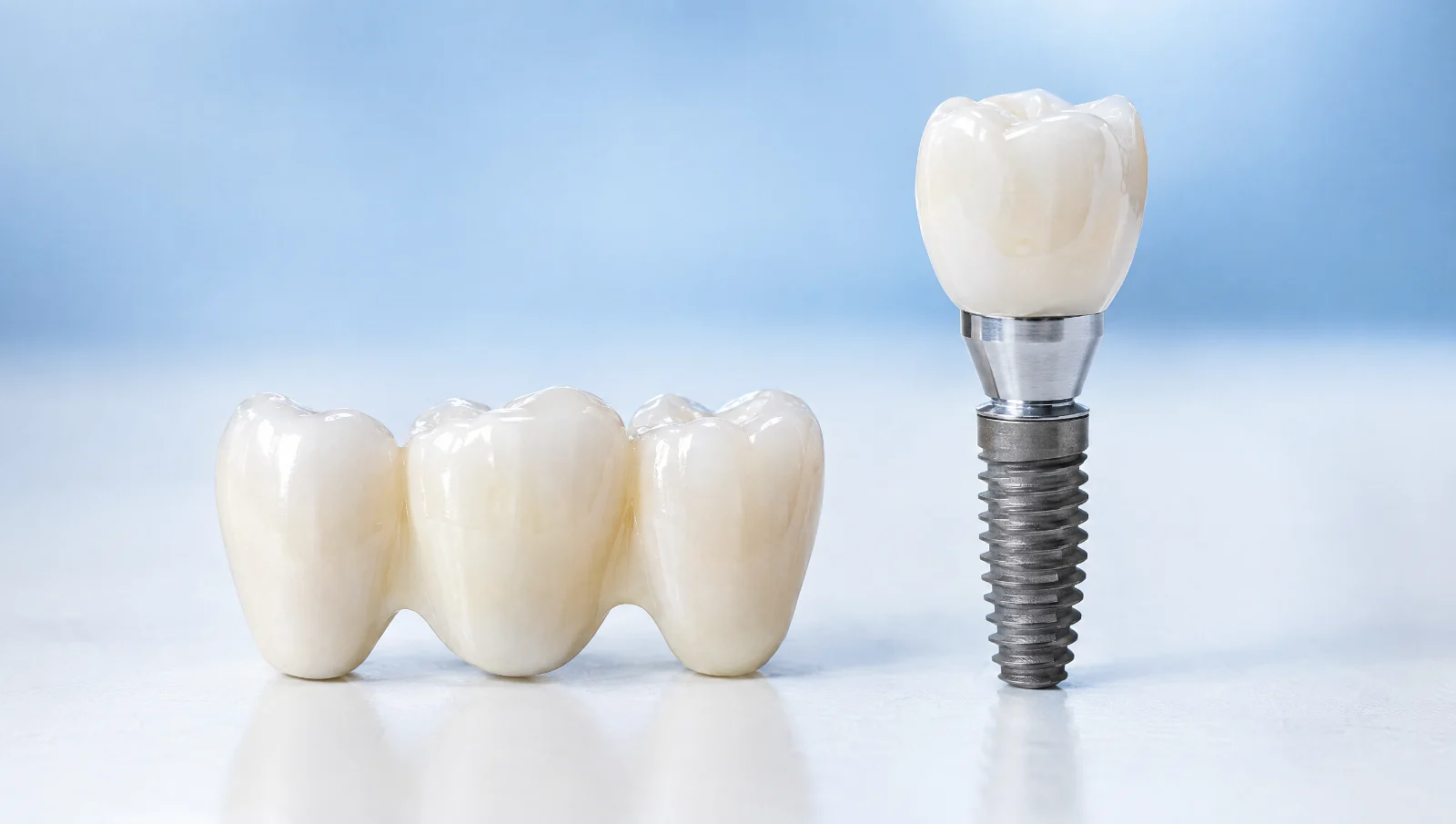
You lost a tooth—or you are about to. Now every dentist you talk to has a different recommendation: a bridge, an implant, an implant bridge. Here is how Dr. John Mady explains the choice to patients in Maywood, without a sales pitch: what each option is, what it costs in Bergen County, how long it lasts, and the situations where a bridge is truly the better answer.
A dental implant replaces the root and the tooth: a titanium post in the jaw with a crown on top. A dental bridge replaces only the visible tooth by anchoring a false tooth to crowns on the two neighbors. For one missing tooth with healthy neighbors, an implant is usually the better long-term investment—it preserves bone, leaves adjacent teeth alone and can last a lifetime. A bridge is the smarter choice when the neighboring teeth already need crowns, when bone or health rule out surgery, or when you need a fixed tooth quickly and affordably.
At Spring Valley Dental Care in Maywood, Dr. Mady does both—and will tell you which fits your mouth, not which is more profitable.
What a bridge and an implant actually are
Dental bridge
A traditional fixed bridge is three (or more) connected porcelain or zirconia teeth. The two on the ends are crowns that fit over your natural teeth on either side of the gap; the one in the middle (the “pontic”) fills the space. The neighboring teeth are shaped down to make room for their crowns, the bridge is cemented on, and it stays put—you brush it and floss under it. Two visits, about two to three weeks.
Dental implant
An implant replaces the root. A small titanium post is placed in the jawbone where the tooth was; over three to six months the bone fuses to it. A custom abutment then connects a ceramic crown to the implant. The neighboring teeth are never touched. Because the implant stimulates bone like a natural root, the jaw stays full instead of shrinking under the gap.
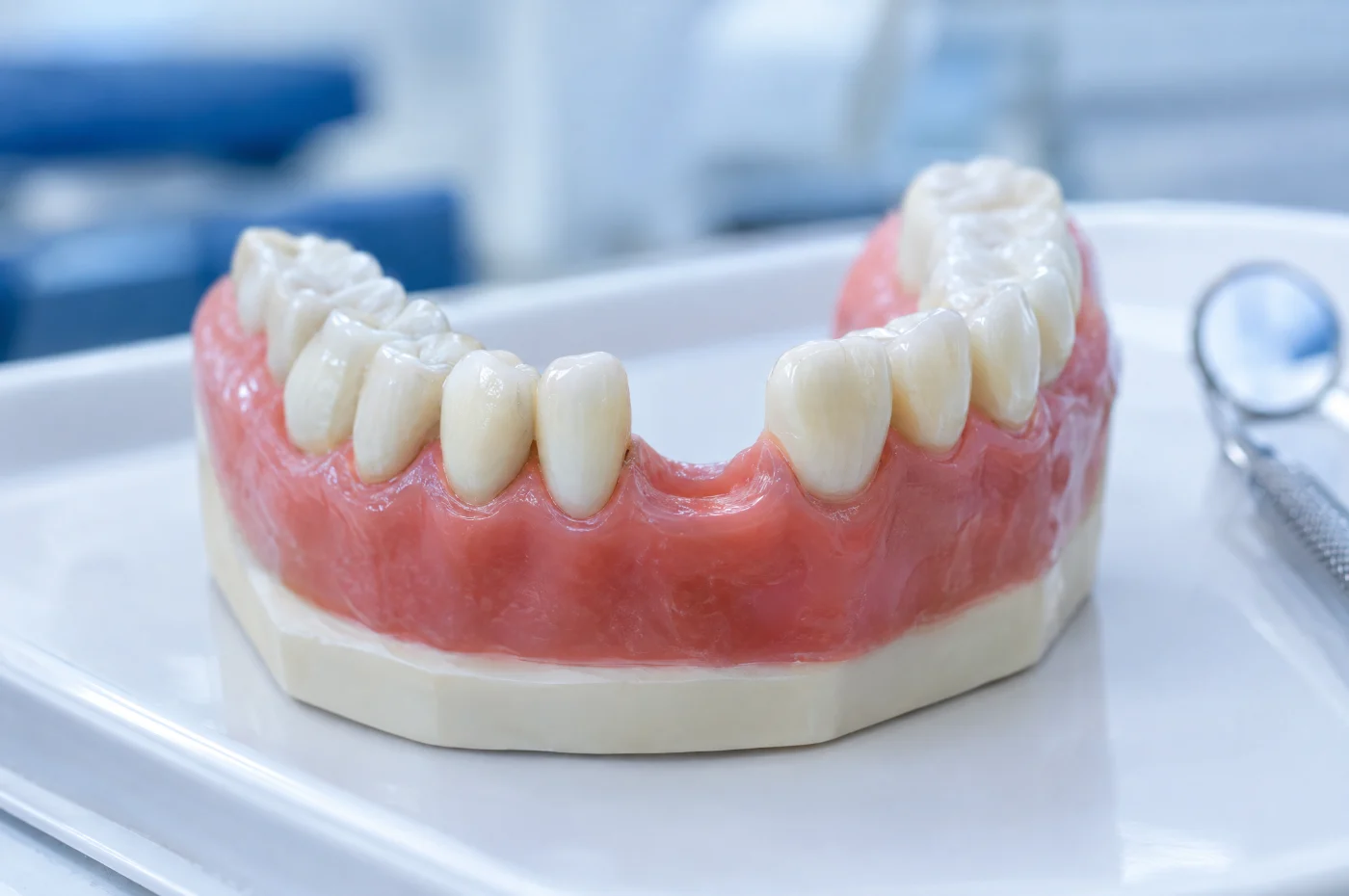
Bridge vs. implant, side by side
| Dental implant | Fixed bridge | |
|---|---|---|
| Replaces | Root and tooth | Visible tooth only |
| Neighboring teeth | Untouched | Ground down for crowns |
| Jawbone | Preserved—implant stimulates bone | Continues to shrink under the gap |
| Lifespan | 25+ years, often lifetime | 7–15 years |
| Time to finish | 3–6 months (temporary tooth meanwhile) | 2–3 weeks |
| Surgery | Yes—minor, with sedation available | No |
| Cleaning | Brush and floss like a natural tooth | Floss threader under the pontic |
| Typical NJ cost (2026) | $4,000–$7,000 all-in | $2,500–$5,000 |
| Insurance | Partial coverage increasingly common | Usually covered at 50% |
When an implant is the right call
- The neighboring teeth are healthy. Grinding down two sound teeth to hold a bridge is the biggest hidden cost of a bridge. An implant leaves them alone.
- You want it to last. Implants have a success rate above 95% and rarely need replacing; bridges are redone every decade or so, often with more extensive work each time.
- You want to protect your jawbone. Bone under a bridge keeps shrinking. Over years that changes your gum line and eventually your face; an implant prevents it.
- You are missing a back tooth. Molars take the most chewing force; a single implant handles it better than a long-span bridge.
- You grind or clench. Heavy bites break bridges. Implants (with a night guard) hold up better.
When a bridge is the honest answer
We place a lot of implants, and we still recommend bridges regularly. A fixed bridge is the better choice when:
- The neighboring teeth already need crowns. If both teeth beside the gap are cracked, heavily filled or decayed, crowning them was going to happen anyway—a bridge fixes three problems with one restoration.
- Bone is insufficient and grafting isn’t an option. Some patients can’t or don’t want to have bone rebuilt; a bridge needs no bone at all.
- A medical condition makes surgery unwise. Uncontrolled diabetes, certain medications, heavy smoking or radiation history can compromise implant healing.
- Timeline matters. A bridge is finished in weeks; an implant takes months.
- Budget is fixed right now. A bridge costs less up front. We will tell you plainly what the long-term trade-off is and let you decide.
Bridges at Spring Valley Dental Care are made in zirconia or ceramic by Glidewell Laboratories in California from a digital scan—no gooey impressions—and typically delivered in two visits. More on alternatives to implants →
Missing several teeth? Consider an implant bridge
When three or four teeth in a row are missing, you don’t need an implant for each one. An implant-supported bridge rests on two implants and spans the gap—no natural teeth ground down, no long-span traditional bridge flexing under load. For an entire arch, a fixed All-on-X bridge on four to six implants replaces every tooth permanently, often with temporary teeth the same day.
What bridges and implants cost in Bergen County
In northern New Jersey in 2026, a traditional three-unit bridge typically runs $2,500–$5,000; a single implant with custom abutment and crown about $4,000–$7,000; an implant-supported bridge replacing three or four teeth roughly $8,000–$15,000. Most dental plans cover bridges at around 50%, and a growing number cover part of implant treatment. We verify your dental and medical benefits and quote both options in writing so the comparison is apples to apples. Financing through CareCredit, Alphaeon and Cherry is available. Read our full breakdown of dental implant costs in New Jersey.
Not sure which one you need? Ask.
Book a free consultation in Maywood. Dr. Mady reviews your 3D scan with you and quotes both a bridge and an implant in writing—then you choose.
Bridge vs. implant FAQ
Is a dental bridge or an implant better?
How much does a dental bridge cost in NJ?
How long do bridges and implants last?
Does a bridge damage the teeth next to it?
Can I get an implant if I’ve had a missing tooth for years?
What is an implant-supported bridge?
Do you do bridges and implants in the same office?
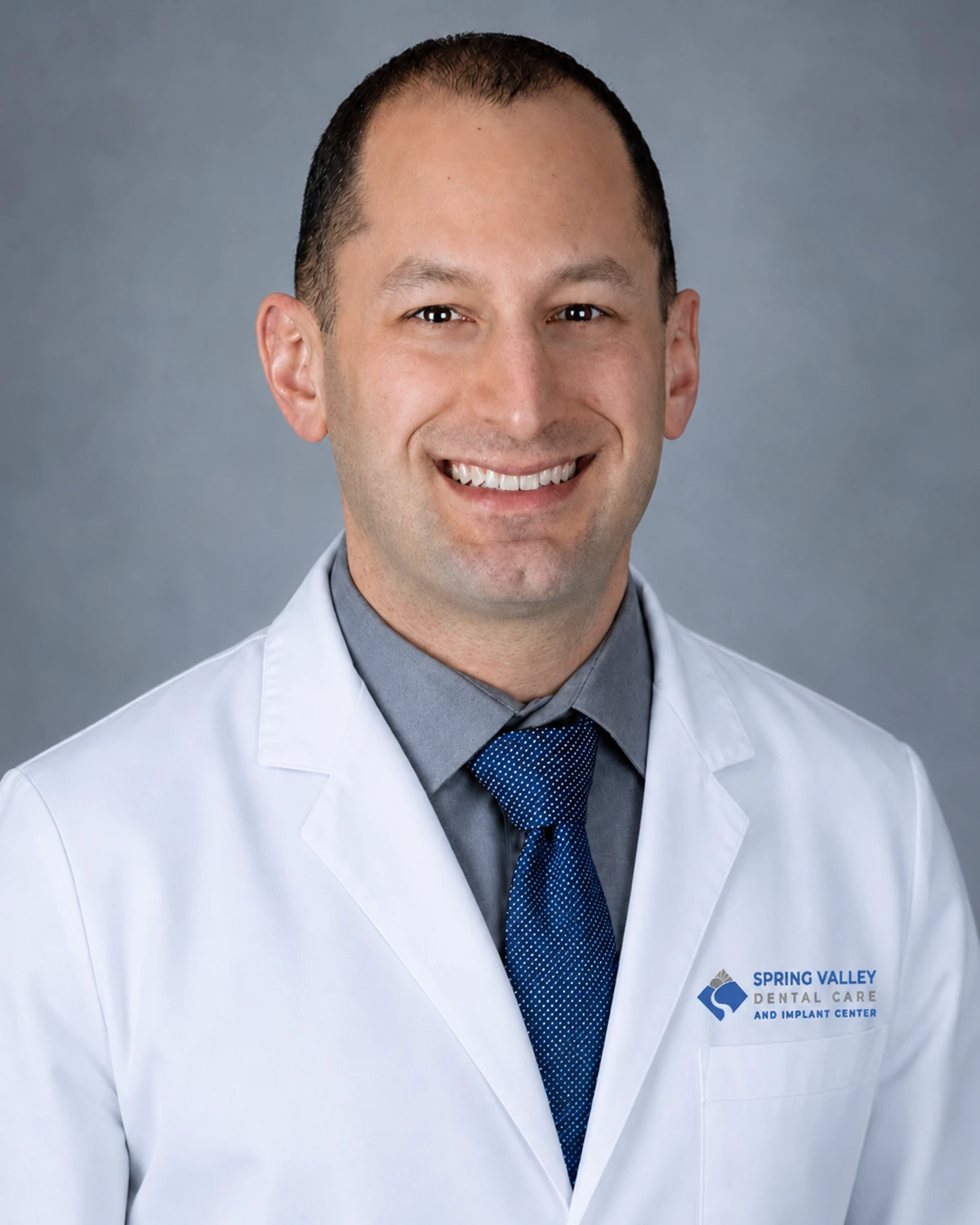
Dr. John Mady, DDS, FAGD, AFAAID
Owner of Spring Valley Dental Care & Implant Center in Maywood, NJ—the practice his father founded in 1977. NYU-trained, a Fellow of the Academy of General Dentistry, an Associate Fellow of the American Academy of Implant Dentistry, and licensed in IV sedation. He places and restores dental implants, including full-arch All-on-X, in his own office. Meet Dr. Mady →


New to our office? Start here.
Limited exam & X-ray
A focused visit for one concern.
Schedule OnlineExam, X-rays & cleaning
The full picture plus a cleaning.
Schedule OnlineImplant consultation
No fee, no obligation.
Book Consultation