


When you're missing one or more teeth, you have options — but not all options are created equal. Understanding the differences between dental implants, dental bridges, dentures, and even doing nothing at all is critical to making the best decision for your long-term health, comfort, and confidence.
At Spring Valley Dental Care in Maywood, NJ, Dr. John Mady takes the time to walk every patient through their alternatives honestly and thoroughly. As an Associate Fellow of the American Academy of Implant Dentistry, he's uniquely qualified to help you understand not just what each option does today — but how it will hold up five, ten, and twenty years from now.
📄 On This Page
A dental implant is a small titanium screw that is placed directly into the jawbone to serve as an artificial tooth root. Once the implant integrates with the surrounding bone — a natural process called osseointegration — an abutment and custom crown or bridge is attached on top, giving you a replacement tooth that looks, feels, and functions just like the real thing.
Implants have been researched for approximately three-quarters of a century. The science behind them is proven, the materials are biocompatible, and when placed by an experienced implant dentist like Dr. Mady, they are comfortable, seamless, and can last a lifetime.
But implants aren't the only option — and depending on your situation, an alternative may be appropriate. Let's compare them all.
| Factor | Do Nothing | Denture / Partial | Tooth-Supported Bridge | Implant Crown or Bridge |
|---|---|---|---|---|
| Bone Loss / Jaw Atrophy | Continues | Continues | Continues | ✓ None — preserves bone |
| Speed of Treatment | N/A | Slow (multiple fittings) | Fast (1–2 weeks) | ✓ Teeth in a day possible |
| Comfort | Low (shifting teeth) | Low (slipping, sore spots) | High | ✓ High — feels natural |
| Impact on Neighboring Teeth | Shifting, decay risk | Clasps wear on teeth | Requires grinding down healthy teeth | ✓ None — stands alone |
| Ability to Floss | N/A | Removable for cleaning | Cannot floss between pontic | ✓ Brush & floss normally |
| Diet Restrictions | Varies | Many (no sticky/hard foods) | Minimal | ✓ None — eat anything |
| 10-Year Success Rate | N/A | < 50% | ~90%* | ✓ 97% |
| Lifespan | N/A | 5–10 years | 7–15 years | ✓ Lifetime (with care) |
*Bridge success rates assume healthy supporting teeth and good oral hygiene.

A dental bridge can be a good alternative to dental implants for some patients. It consists of several crowns splinted together — the adjacent teeth on either side of the gap are "prepped" (shaved down) and the bridge is cemented over them, with a false tooth (pontic) filling in the missing space.
Whether you opt for a bridge or an implant, the final restoration feels natural and comfortable. In many cases, you'll forget which teeth are your natural teeth and which are artificially restored.
Who should consider a bridge? Bridges are a reasonable option when the adjacent teeth already have large fillings or crowns and would benefit from being crowned anyway. They're also a good choice for patients who are not surgical candidates or who need a faster, lower-cost solution. Dr. Mady will always be transparent about which option makes the most clinical sense for your specific situation.
Polypharmacy (taking multiple medications) and parafunction (clenching or grinding your teeth) can cause early failure of dental bridges, including tooth decay under the crowns and fracture of the supporting teeth. If either of these factors apply to you, Dr. Mady may recommend a dental implant instead, as implants are not susceptible to decay and are far more resistant to the forces of clenching and grinding.
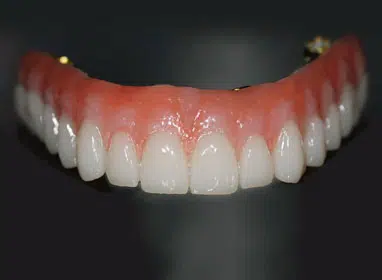
Traditional dentures and partial dentures are removable appliances that replace missing teeth by resting on top of the gums. A flipper is a lightweight, temporary partial denture that's often used as a short-term placeholder while a permanent solution is being planned.
For decades, dentures were the only option for patients missing most or all of their teeth. While they're still widely used, modern alternatives like All-on-X dental implants and implant-supported overdentures have fundamentally changed what's possible.
Tired of your dentures? Many of our Bergen County patients transition from dentures to a permanent All-on-X fixed implant bridge — a fixed, non-removable set of teeth supported by just four to six implants per arch. It's the single most life-changing upgrade we offer. Learn more about All-on-X →
Some patients wonder if they can simply leave the gap and skip treatment altogether. While it may seem like the easiest path in the short term, doing nothing is itself a decision with real consequences:
The bottom line: replacing a missing tooth sooner is almost always better than later. Even if you're not ready for implants today, Dr. Mady can help you create a treatment plan that fits your timeline and budget.
The reason dental implants have a 97% ten-year success rate — dramatically higher than bridges or dentures — comes down to one fundamental advantage: implants cannot decay.
The support teeth for a traditional bridge are still natural teeth, and natural teeth are susceptible to cavities. When decay develops under a bridge crown, it can compromise the entire bridge. Dentures face a different problem — without stimulating the jawbone, they accelerate the very bone loss that makes them fit worse over time, creating a vicious cycle of relining and replacement.
Dental implants eliminate both of these failure modes. The titanium post integrates permanently with the jawbone, preserves bone density, and cannot develop cavities. With proper oral hygiene and regular checkups at our Maywood, NJ office, your dental implant can truly last a lifetime.
Most healthy adults with one or more missing teeth are candidates for dental implants. During your free consultation, Dr. Mady will use 3D imaging to evaluate your bone density, gum health, and overall suitability. Factors that support a successful implant include adequate jawbone volume, healthy gums, good general health, and a commitment to oral hygiene.
Been told you're not a candidate? Get a second opinion. Advances in digital dentistry and 3D imaging have expanded candidacy significantly. Many patients who were turned away elsewhere are successfully treated at Spring Valley Dental Care.
Not every missing tooth requires an implant. If the teeth adjacent to the gap already have large restorations and would benefit from crowns anyway, a bridge can be an excellent and cost-effective solution. If you have a medical condition that makes surgery inadvisable, or if you need a replacement quickly without waiting for implant healing, a bridge may be the right call. Dr. Mady will always give you his honest recommendation — even when that means suggesting a less expensive alternative.
Yes. All-on-X therapy involves replacing all your teeth with a minimum of four implants in each arch. In many cases, you'll receive a temporary bridge in just one day. It's the most comprehensive solution we offer for patients with failing or missing teeth — and it eliminates the need for removable dentures entirely.
As few as one or two appointments, depending on your case. Treatment plans vary — the average is closer to seven appointments total, spread over 3–6 months. IV sedation and proper numbing ensure comfort throughout every visit.
In most cases, yes — the upfront cost of a bridge is typically lower than an implant. However, bridges need to be replaced every 7–15 years, while implants can last a lifetime. Over 20+ years, implants are often the more cost-effective choice. Visit our Cost Explained page for a detailed breakdown.
Absolutely. Many of our Bergen County patients make this transition. Whether you upgrade to a fixed All-on-X implant bridge or implant-supported snap-on overdentures, the improvement in comfort, function, and confidence is dramatic.
The surrounding teeth will shift, bone loss will accelerate, and the gap will become progressively harder and more expensive to treat. We always recommend replacing missing teeth as soon as possible to prevent these complications.
Many insurance plans provide partial coverage for both implants and bridges. Our team will verify your benefits before treatment. For patients without insurance, we offer a $287/year membership plan and flexible payment plans.
The best way to find out is a one-on-one conversation with Dr. Mady. During your free consultation, he'll evaluate your specific situation with 3D imaging, discuss all your options transparently, and help you make the decision that's right for your health, your goals, and your budget.
Schedule a free consultation with Dr. Mady. We'll evaluate your situation, explain all your options, and give you an honest recommendation — no pressure.
Free limited exam and X-ray — a $135 value.
Schedule Your Free ConsultationSpring Valley Dental Care | 930 Spring Valley Rd, Maywood, NJ 07607 | (201) 843-3312